

Jump to Sections:
Reinventing Community
Technology’s Role in Engagement
Becoming the Fitness Epicenter
What This Reinvention Means for Gyms
A Closer Look at the Top 10 Fitness Trends
Reinventing Community
In 2000, Robert D. Putnam wrote Bowling Alone, chronicling the decline in community engagement across America. We were collectively lonelier, more isolated, and less social. Enter pickleball. Although it’s a stretch to suggest the world’s most competitive senior sport (my opinion) might save America from itself, follow my logic. This December, ACSM published its annual report on top fitness trends for 2026. Among its findings was an intersection of technology and community reshaping fitness for people of all ages. At its core, fitness is no longer an elite pursuit but an excuse to hang out with friends while staying active. How did this happen?
ACSM’s Top Fitness Trends for 2026
- Wearable technology
- Fitness for older adults
- Exercise for weight management
- Mobile exercise apps
- Balance, flow, and core strength classes
- Exercise for mental health
- Strength training
- Data-driven technology
- Adult recreation and sport club involvement
- Functional fitness training
Technology’s Engaging All of Us
Not surprisingly, sport watches (aka “wearable technology”) rank #1 in ACSM’s survey. Their arrival placed health squarely in our hands and—coupled with the growth of social media—created a tidal wave. Yet remarkably, instead of pulling us apart, the tsunami brought us together. Now, we are all checking our metrics, adapting our workouts at a seismic pace, and relying on new digital and pharmacological tools. Today’s fitness trends are reinventing what it means to be healthy—and, in an ironic twist of events, encouraging us to have fun again.
Gyms are the Epicenter of This Fitness Metamorphosis
How your gym can capitalize on these advances:
Encourage data-driven training programs. Wearable technology’s immediate feedback allows trainers to make real-time adjustments while delivering measurable progress over time.
Market to older adults. Seniors visit gyms more than any other age group and come in a wide range of health. Age is no longer a predictor of capability or willingness to try new services.
Recognize demographic fitness shifts. Younger, well-educated females gravitate toward mobile apps and weight training. Seniors and beginners prefer structured classes and community-driven experiences. This second group is focused on staying fit for activities of daily living, better mental health, and making friends. Don’t think of this as stereotyping. It’s acknowledging fitness’ place in the seasons of our lives, to accidentally quote Earth Island’s ‘70’s hit song.
Educate members on skill-based fitness. Functional fitness and strength training are learned activities. True, almost anyone can pick up a barbell or jump up and down, but the sauce is in the skill. Clinics in lifting technique, alternative exercises, and everyday functional training will build long-term interest in the back half of your gym. Don’t underestimate how few people know what we know.
What This Fitness Re-invention Means for Gyms
Pursuing physical and mental health is now an everyday activity. Mindfulness, meditation, and relaxation are no longer reserved for boutique studios. Playful competition and movement for its own sake has reentered the conversation. As Putnam recognized in 2000, an engaged community is a stronger one – physically, emotionally, and mentally. For your gym, this shift to group exercise becomes an opportunity to establish a long-term base of dedicated members, whose reasons for visiting extend far beyond the gains.
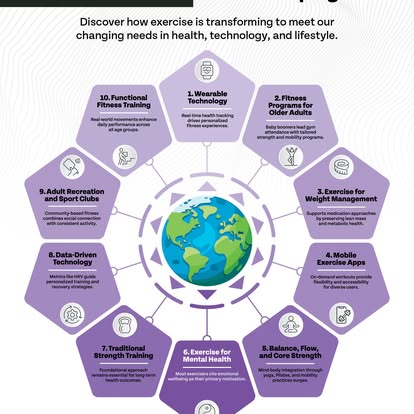
A Closer Look at the Top 10 Fitness Trends
1. Wearable Technology
Remarkably, nearly half of adults now own a fitness tracker or smartwatch. The data can be inconsistent but is useful for tracking patterns over time. These watches have been revolutionary in adding the phrase “getting my steps,” into our everyday vernacular.
2. Fitness Programs for Older Adults
Baby Boomers will soon be the largest adult population in U.S. history. Adults over 65 visit the gym more often than any other age group. But don’t call them “seniors.” This population requires programs incorporating balance, mobility, resistance training and low impact cardiovascular activity.
3. Exercise for Weight Management
The introduction of medications into controlling obesity has given rise to effortless weight loss. However, research shows exercising throughout weight loss has proven to lead to greater fat loss and preservation of more lean mass.
4. Mobile Exercise Apps
With a remarkable 345 million users, mobile apps can supplement professional training when used strategically by coaches.
5. Balance, Flow, and Core Strength
This trend bridges the desire for movement with increased mental wellbeing. Appealing to all ages, these classes improve mobility and core strength allowing for better and safer strength and cardio training.
6. Exercise for Mental health.
Individuals are turning to exercise as a counterbalance to hectic, technology-engulfed lives. Psychologists are now acknowledging “exercise is one of the most effective strategies we have to improving mental health build emotional resilience and enhance overall-wellbeing,” A’Naja M. Newsome, PhD, ACSM-CEP, EIM.
7. Traditional Strength Training
Although it feels as though interest in strength trainings exploded, only about 30% of adults weight lift regularly. This gap can be bridged by creating progressive, accessible strength training programs and incorporating weight training into group classes.
8. Data-Driven Technology
More than 70% of individuals use their wearable’s data to plan training and recovery. This overwhelming willingness to apply real-time stats to their fitness experience opens avenue for sharp professionals to better tailor and sculpt proper exercise prescriptions.
9. Adult Recreation and Sports Clubs
New to the top 20 list, these activities are as much about fitness as they are about social connections and fun. Incorporating recreational activities into gym offerings tears down barriers to exercise and builds the habit of fitness in those who might never visit a gym.
10. Functional Fitness Training
Incorporating strength, power, mobility and endurance, functional fitness is often associated with injury rehabilitation, yet it offers a myriad of real life applications. Professionals who incorporate functional fitness into their training open their playbook to a wide variety of clients.
Trends for Gym Insight
We’ve been doing fitness software right since 2007 and we plan to continue in our quest to create the best gym management product in the industry. Our cloud-based platform powers fitness centers nationwide, freeing gym owners’ time while increasing profitability.
Key features include:
- 24/7 digital keytag door access
- Tablet-based sales automation
- Advanced reporting
- Fully integrated, cloud-based gym management platform
Ready to see Gym Insight in action?
📞 Call 855-FOR-GYMS to schedule your personalized demo.